No more endless talks
Erhürman’s four principles seek to correct the structural flaws that have undermined every major Cyprus negotiation since Crans-Montana

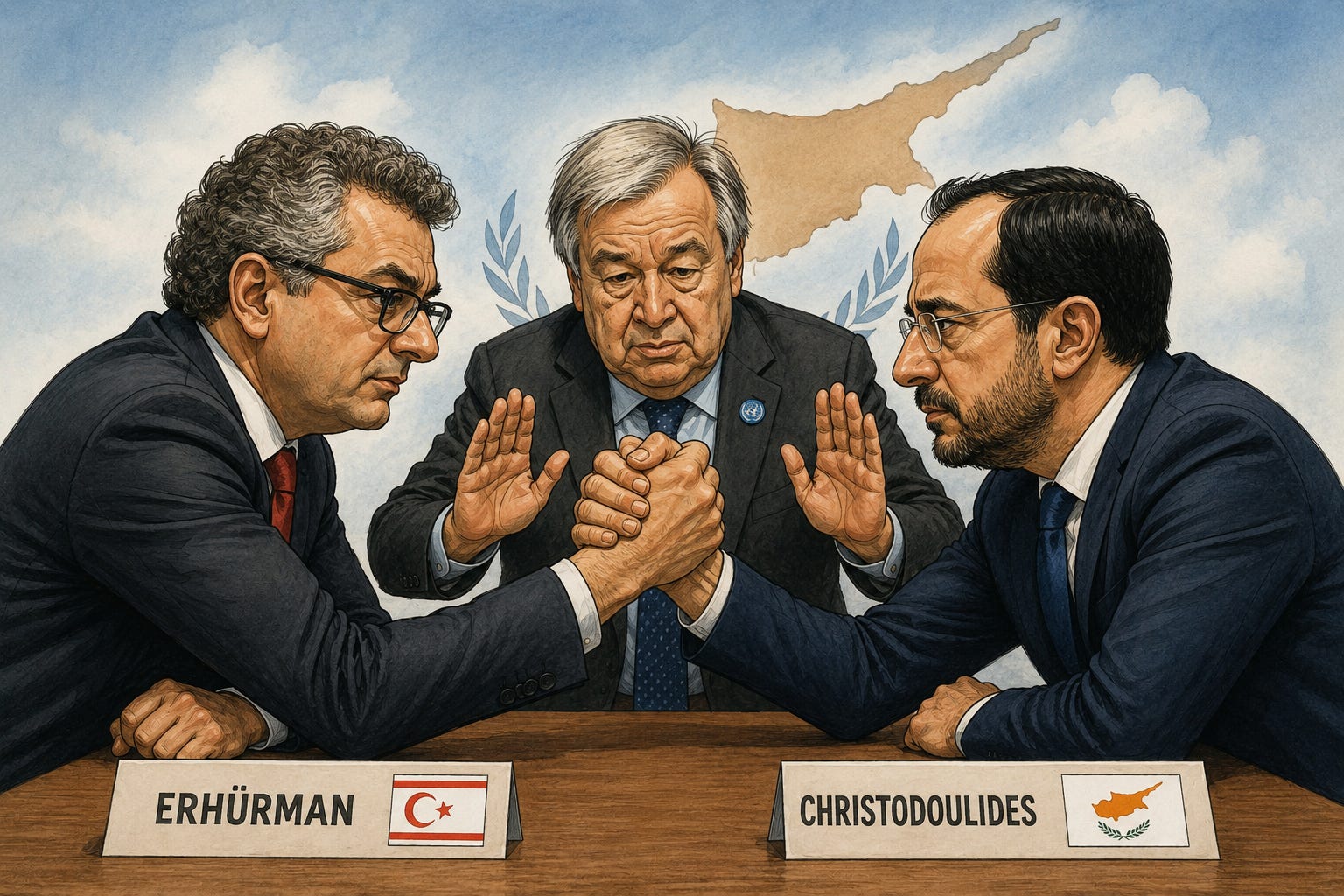
Nearly a decade after the collapse of the Crans-Montana conference, Turkish Cypriot leader Tufan Erhürman is arguing that the real challenge is no longer how to restart Cyprus negotiations, but how to prevent them from repeating the mistakes of the past. His four principles for a new settlement process are designed to ensure that talks are conducted on the basis of political equality, within a defined timeframe, while preserving previous convergences and, most importantly, without allowing another failure to simply restore the existing status quo.
Last week, while in Cyprus to follow the resumption of contacts by UN Secretary General’s Personal Envoy María Ángela Holguín Cuéllar, I was surprised to discover that many of my Greek Cypriot friends, including otherwise well-informed journalists and political observers, were struggling to understand the essence of Turkish Cypriot leader Tufan Erhürman’s four-point methodology. Some viewed it as a new negotiating position, others as a hidden alternative to federation, when in fact it is primarily an attempt to define the rules, parameters and objectives of a meaningful negotiation process before substantive talks begin.
Few moments in the long history of the Cyprus problem have had a greater impact on contemporary Turkish Cypriot political thinking than the collapse of the Crans-Montana conference in July 2017. For many participants, diplomats and observers, the negotiations in Switzerland represented the closest the island had come to a comprehensive settlement since the division of Cyprus. United Nations Secretary-General António Guterres personally intervened in the process and placed before the parties a framework intended to bridge the remaining differences on governance, territory, security, guarantees and power-sharing. The prevailing view among many international officials was that the parties stood within reach of an agreement.
Yet the talks collapsed.
For Turkish Cypriots, the significance of Crans-Montana was not limited to the collapse of the talks themselves. What proved truly transformative was what happened afterwards. As had occurred following numerous previous failed initiatives, the end of negotiations brought no meaningful change to the political realities on the island. The Greek Cypriot side simply returned to the advantages it had enjoyed before the conference. It remained the internationally recognized government of Cyprus, continued to benefit from all the rights and privileges of European Union membership, and maintained its standing within international institutions and diplomatic forums. Turkish Cypriots, meanwhile, found themselves once again confronting the familiar realities of political isolation, economic restrictions, limited international engagement and continued uncertainty about their future. For many within the Turkish Cypriot community, the lesson was stark: regardless of how constructively they participated in negotiations, failure invariably restored an unequal status quo in which one side resumed business as usual while the other continued to bear the consequences of the unresolved conflict.
The experience reinforced a growing perception that the Cyprus negotiation process had become structurally imbalanced. One side could afford failure because the status quo largely served its interests. The other paid the price every time diplomacy failed. It was this realization that ultimately shaped Erhürman’s approach to the question of how a new process should be structured.
Rather than simply advocating a return to negotiations for their own sake, Erhürman has argued that any new substantive process must begin with four clearly defined principles. These principles are not intended as preconditions designed to prevent talks. They are intended to ensure that talks have a realistic chance of succeeding.
Political equality is not negotiable
The first and most important principle concerns political equality. Erhürman has repeatedly argued that political equality cannot be treated as a subject to be negotiated during a new process because it has already been recognized by the United Nations as one of the foundations of a settlement. In his view, if political equality is not accepted at the outset, there is little reason to begin substantive negotiations at all.
This position reflects a long-standing Turkish Cypriot concern. Throughout decades of negotiations, the central question has never been whether Turkish Cypriots would participate in a future federal partnership but whether that participation would be meaningful. Political equality, from the Turkish Cypriot perspective, is not merely symbolic representation. It is the practical guarantee that Turkish Cypriots will be able to participate effectively in governance and that the future state will function as a genuine partnership rather than as a majoritarian system dominated by the larger community.
Two elements have traditionally formed the cornerstone of this understanding.
The first is the principle of a rotating presidency. Turkish Cypriots have long maintained that if a future federal partnership is genuinely to reflect the political equality of the two constituent states, both communities must periodically occupy the highest executive office. The concept is rooted in the partnership philosophy of the 1960 Republic of Cyprus, where the Turkish Cypriot community held the vice presidency with constitutionally guaranteed powers. In the context of a future settlement, a rotating presidency is therefore viewed not as a concession or privilege, but as a natural and visible expression of political equality and shared ownership of the state.
The second is effective participation in decision-making. For Turkish Cypriots, political equality cannot be reduced to numerical representation in institutions. It must also be reflected in the ability to influence decisions and prevent unilateral domination by the larger community. This is why Turkish Cypriot negotiators have consistently insisted that at least one favorable Turkish Cypriot vote should be required for decisions in areas affecting federal governance and the vital interests of both constituent states. Such arrangements are intended to ensure that Turkish Cypriots become genuine partners in governance rather than a permanently outvoted minority within institutions ostensibly established to govern the island jointly. In Turkish Cypriot thinking, rotating presidency and effective participation are not separate demands but complementary mechanisms that give practical meaning to the principle of political equality.
For Erhürman, these issues are not bargaining chips to be traded during negotiations. They are elements that define whether a future partnership would genuinely rest on political equality. If there is no acceptance of political equality, effective participation, rotating presidency and meaningful involvement in decision-making from the outset, then the very rationale for negotiations becomes questionable.
As he has repeatedly suggested, there is little point in sitting at a negotiating table if one of the fundamental principles underpinning the talks remains contested.
Negotiations must have an end point
The second principle addresses another recurring weakness of previous Cyprus initiatives: the absence of a clear timetable.
The history of Cyprus negotiations is littered with examples of open-ended processes that gradually evolved into diplomatic routines. Meetings continued, technical committees were established, confidence-building measures were discussed and international envoys shuttled between capitals. Yet because there was no clear endpoint, difficult decisions were often postponed indefinitely.
Erhürman argues that a new process must be time-bound and result-oriented. The parties must know from the beginning that negotiations are not intended to continue forever. There must be a clearly defined period during which substantive issues are addressed and decisions are taken.
This does not mean imposing unrealistic deadlines or artificial pressure. Rather, it means creating a framework in which negotiations move steadily toward a conclusion. Without such a structure, there is a risk that talks become an objective in themselves rather than a means of reaching a settlement.
The insistence on a timetable also reflects broader public fatigue. Many Turkish Cypriots have spent their entire lives hearing that a solution may be around the corner. For younger generations in particular, endless negotiations have become synonymous with endless uncertainty. A defined timeframe would help restore credibility to a process that many increasingly view with skepticism.
Building on what already exists
The third principle concerns the preservation of previous convergences.
Successive generations of negotiators have invested enormous effort in discussions on governance, territory, property, economic arrangements, European Union matters and institutional structures. While significant disagreements remain, a substantial body of work has already been accumulated through decades of negotiations.
Erhürman argues that a new process cannot begin by disregarding these achievements. To do so would effectively condemn negotiations to repeating discussions that have already taken place countless times.
The preservation of convergences is important for another reason. It protects continuity in the peace process. Political leaderships change. Governments come and go. Yet if every election results in the abandonment of previous understandings, the prospect of reaching a settlement becomes increasingly remote.
For Erhürman, preserving convergences is not about freezing negotiations. It is about ensuring that progress achieved through years of effort is not casually discarded for short-term political considerations.
No return to the status quo
The fourth principle has attracted perhaps the greatest attention because it addresses the issue that has haunted Turkish Cypriot thinking since Crans-Montana.
According to Erhürman, if a new negotiation process fails, there can be no return to the status quo.
This principle is often misunderstood. It does not imply a predetermined alternative model or an automatic shift toward a particular political outcome. Rather, it reflects a refusal to accept that Turkish Cypriots should once again bear the consequences of a failed process while the broader international environment remains unchanged.
The existing status quo is inherently asymmetrical. One side enjoys international recognition, membership in the European Union and unrestricted participation in global political and economic structures. The other remains isolated despite repeatedly demonstrating support for negotiated settlement efforts.
The 2004 Annan Plan referendum remains perhaps the most striking example of this imbalance. Turkish Cypriots approved the UN plan. Greek Cypriots rejected it. Yet the rewards and consequences that followed bore little relationship to the choices made by the two communities.
Crans-Montana reinforced the same perception. Once again, negotiations failed. Once again, Turkish Cypriots returned to isolation while the international system continued to function largely as before.
Erhürman’s argument is that such an outcome cannot be repeated indefinitely. If a new process is launched on the basis of political equality, within a defined timetable and with genuine commitment from all parties, then failure must lead to a reassessment of existing realities. The international community cannot simply reset the clock and prepare for another round of talks several years later.
The significance of this principle lies in the way it alters incentives. For decades, the Cyprus process has operated within a framework in which the consequences of failure have been highly uneven. The side benefiting most from the existing arrangements faced relatively limited costs if negotiations collapsed. The side disadvantaged by the status quo paid the greater price.
By insisting that there can be no return to the previous situation, Erhürman is seeking to create a more balanced negotiating environment in which all parties have a genuine stake in success.
Beyond process management
Taken together, Erhürman’s four principles represent something more than a negotiating position. They constitute an effort to address the structural weaknesses that have repeatedly undermined settlement efforts.
Political equality establishes the foundation of a future partnership. A clear timetable ensures that negotiations move toward a conclusion. Preservation of convergences prevents the process from endlessly restarting. The rejection of a return to the status quo introduces accountability and consequences.
The common thread running through all four principles is a desire to move beyond what many Turkish Cypriots view as the era of process management. For decades, the Cyprus problem has been managed rather than resolved. Negotiations have often become exercises in maintaining diplomatic activity rather than producing political outcomes.
Nearly ten years after Crans-Montana, Erhürman’s message is that restarting talks is not enough. The real challenge is creating conditions in which negotiations have a realistic prospect of success. Without political equality, there is no reason to begin. Without a timetable, there is no urgency. Without preserving convergences, there is no continuity. And without consequences for failure, there is no incentive to compromise.
Whether these principles ultimately become the foundation of a new settlement process remains uncertain. What is clear, however, is that they reflect a profound reassessment of the lessons of the past many decades. For many Turkish Cypriots, the question is no longer whether negotiations should resume. The question is whether a new process can finally be designed in a way that avoids repeating the failures that have defined Cyprus diplomacy for generations.